Country Music History

Honky-Tonk Era

Hank Williams

Hank Williams was a foundational country music singer and songwriter whose standard-setting career established the benchmark for modern country songcraft. Born Hiram Williams in rural Alabama, he formed his band the Drifting Cowboys in the late 1930s and eventually broke out nationally after joining forces with music publisher Fred Rose, scoring early successes with tracks like Move It on Over and his breakout hit Lovesick Blues. After joining the Grand Ole Opry in 1949, Williams dominated the genre with iconic compositions such as Cold, Cold Heart, Hey, Good Lookin', and Your Cheatin' Heart, while also recording moral narrations under the pseudonym Luke the Drifter. Despite his massive success and pop crossover popularity, his life was cut short by severe spinal pain from spina bifida occulta, alcoholism, and drug dependence, leading to his premature death at age twenty-nine on January 1, 1953. Inducted as an inaugural member of the Country Music Hall of Fame in 1961, Williams remains one of American music's most influential and enduring figures.

"Hey, Good Lookin'"

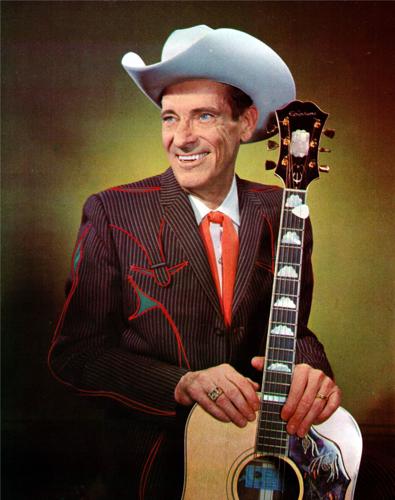
Ernest Tubb

Ernest Tubb was a pioneering honky-tonk country singer, songwriter, and long-standing Grand Ole Opry star whose career spanned over five decades. Born in Texas, he began as a Jimmie Rodgers emulator until a tonsillectomy lowered his vocal register, leading him to develop a distinctive, spare honky-tonk sound supported by electric lead guitar. His breakout self-penned hit, Walking the Floor Over You, launched him to national stardom in 1941 and opened the doors to a 39-year tenure with the Grand Ole Opry. Beyond his influential recordings and frequent duet collaborations with artists like Loretta Lynn, Tubb shaped Nashville culture by opening the Ernest Tubb Record Shop in 1947, launching the Midnite Jamboree radio show, and using his stardom to champion emerging artists, earning a reputation as one of the genre's most generous figures before his induction into the Country Music Hall of Fame in 1965.

"Walking the Floor Over You"

Kitty Wells

Kitty Wells, born Ellen Muriel Deason, was the Queen of Country Music and a groundbreaking pioneer who shattered industry barriers for female artists in a male-dominated genre. Performing initially as a girl singer alongside her husband Johnnie Wright, her career exploded in 1952 with the smash hit It Wasn't God Who Made Honky Tonk Angels, an answer song that topped the charts and became the first single by a solo woman to reach number one on the country charts. Known for her gospel-tinged vocals, weeping steel guitar accompaniment, and modest stage presence, Wells recorded dozens of classic hits—including Making Believe and I Can't Stop Loving You—that gave voice to women's perspectives on heartbreak and social themes. Her massive success proved female artists could headline shows and sell records, paving the way for future generations of women in country music and earning her induction into the Country Music Hall of Fame in 1976 alongside a Grammy Lifetime Achievement Award in 1991.

"It Wasn't God Who Made Honky Tonk Angels"